Fakespot Shuts Down
Fakespot officially shut down its website, browser extensions, and mobile apps on July 1, 2025. Mozilla, which acquired Fakespot in 2023, cited a strategic refocus on Firefox as the reason. For shoppers who relied on it, the shutdown left a real gap.
This article covers what Fakespot did well, where it fell short, and how SeekShop’s approach compares.
The problem both tools were trying to solve
Fake and unreliable reviews on Amazon became such a serious problem that multiple tools emerged to help shoppers navigate the manipulation. Fakespot was the oldest and most recognized name in Amazon review analysis. SeekShop takes a fundamentally different architecture. They weren’t doing the same thing — and understanding the difference explains why one approach outlasted the other.
What Fakespot did and how it worked
Fakespot analyzed reviews on Amazon listings using natural language processing and machine learning to identify patterns associated with fake reviews: review velocity anomalies, suspicious reviewer account profiles, template-like language similarity, and statistical irregularities in rating distributions. Based on this analysis, it assigned a grade from A to F.
The grade told you how suspicious the reviews looked based on Amazon’s own review data. An A grade meant the reviews appeared legitimate by Fakespot’s analysis. An F grade meant significant manipulation patterns were detected.
The core limitation: Fakespot was analyzing Amazon’s compromised dataset. Sophisticated fake review operations studied and adapted to detection tools — staggering timing, diversifying account profiles, and varying language to evade the patterns these tools looked for. Fakespot caught obvious manipulation; it was less effective against sophisticated manipulation designed to evade detection.
There was also a structural vulnerability: as Amazon tightened access to review data in 2024–2025, tools dependent on scraping Amazon directly became increasingly difficult to maintain. This likely contributed to the shutdown, even if Mozilla didn’t say so explicitly.
What SeekShop does differently
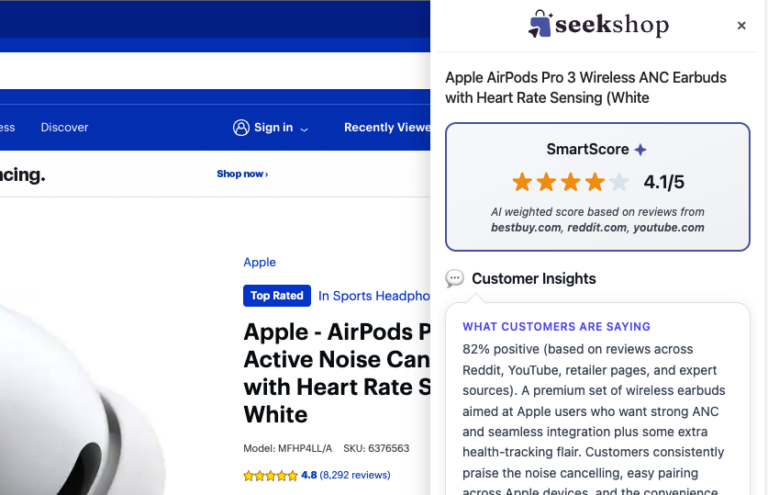
SeekShop’s SmartScore takes a different approach: rather than analyzing Amazon’s reviews for signs of manipulation, it aggregates product sentiment from multiple independent platforms — Reddit, YouTube, retailer pages, and expert sources — and synthesizes a cross-platform quality score.
The logic is straightforward: a seller can engineer Amazon’s rating. Engineering a positive reputation on Amazon, Reddit, YouTube, and dozens of independent retailers simultaneously is exponentially harder — economically and practically infeasible at the scale that single-platform manipulation operates. A product that has genuinely satisfied customers tends to have consistent positive sentiment across independent platforms. A product propped up by fake Amazon reviews typically shows divergence when you look at Reddit and YouTube.
Every SeekShop analysis includes:
- A SmartScore — an AI-weighted rating based on cross-web sentiment
- A sentiment breakdown (e.g. “88% positive based on reviews across Reddit, YouTube, retailer pages, and expert sources”)
- What customers consistently praise
- The main criticism or caveat
- A trust signal when review coverage is thin or suspiciously one-sided
- A plain-English Takeaway so you know exactly who the product is and isn’t for
Where each approach was stronger
For detecting suspicious Amazon review patterns: Fakespot’s granular breakdown of specific Amazon review patterns was detailed and transparent. If your specific question was “do these Amazon reviews look fake?”, Fakespot’s letter grade system gave a clear answer.
For evaluating overall product trustworthiness: SeekShop’s cross-platform approach is significantly more informative. A product can have legitimate-looking Amazon reviews and still be a poor product — the reviews are just from buyers who had different expectations. The SmartScore reflects genuine cross-platform customer satisfaction, not just whether reviews look suspicious on one platform.
For sophisticated fake reviews: SeekShop has a structural advantage. Because the SmartScore draws from Reddit and YouTube alongside retailer pages, sellers who’ve invested in making fake reviews look authentic still face the challenge that their product doesn’t generate genuine organic discussion on independent platforms. A product that would have passed Fakespot’s analysis but has no organic Reddit presence is still a red flag in SeekShop’s scoring.
For long-term sustainability: Fakespot’s dependence on Amazon review data made it structurally vulnerable. SeekShop’s cross-web approach isn’t dependent on any single platform’s data access — which is part of why it’s still here.
What Fakespot got right
Fakespot deserves credit for making review skepticism mainstream. Before Fakespot, most shoppers took Amazon star ratings at face value. Fakespot made it normal to ask “can I trust these reviews?” — and that’s a genuinely useful shift in how people shop online.
SeekShop answers the same underlying question, just with a broader and more resilient data set.
Common misconceptions
A Fakespot A grade didn’t mean the product was good. It meant the reviews passed Fakespot’s manipulation detection. A genuinely mediocre product with authentic reviews would receive an A grade. The grade spoke to review authenticity, not product quality.
SeekShop and Fakespot weren’t competitors in the typical sense. They analyzed different things. Fakespot was a review authenticity tool; SeekShop is a product quality tool that includes review authenticity as one component.
Neither tool is foolproof. Review manipulation is an adversarial problem. Any tool’s assessments should be treated as probabilistic signals, not definitive verdicts.
Try SeekShop free — two ways
Install the Chrome Extension Get SeekShop analysis on any product page as you shop — no switching tabs, no copying URLs. Works across 1,000+ stores.
Use the Web Tool — No Install Required Paste any product URL and get a full analysis instantly. No account needed.
Frequently asked questions
What happened to Fakespot? Mozilla, which acquired Fakespot in 2023, shut it down on July 1, 2025 as part of a broader refocus on Firefox.
Is SeekShop free? Yes — both the Chrome extension and the web tool are free. No account required.
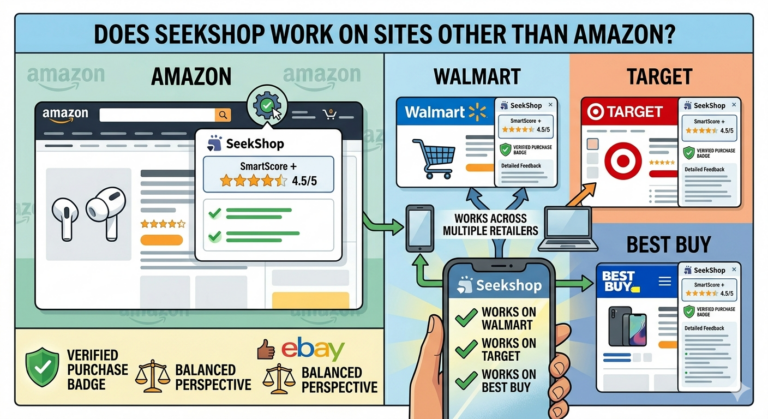
Does SeekShop work on sites other than Amazon? Yes. SeekShop aggregates data from Reddit, YouTube, retailer pages, and expert sources across 1,000+ stores — not just Amazon.
Does SeekShop detect fake reviews? SeekShop doesn’t grade individual reviews for authenticity. Instead it aggregates sentiment from across the web, so you’re never relying on one platform’s review pool alone. A product with manufactured Amazon reviews will look very different when Reddit and YouTube are factored in.
What’s the best Fakespot alternative? SeekShop is the closest alternative for shoppers who want honest, cross-web product analysis. See a full breakdown here.
Bottom line
Fakespot did one thing well: it made shoppers question Amazon’s review pool. SeekShop answers that same question with a broader data set — pulling from Reddit, YouTube, retailer pages, and expert sources to give you a cross-web picture no single-platform tool can match.
Install the SeekShop Chrome extension, or check any product at seekshop.co/review.