TLDR: An Amazon review analyzer breaks down review patterns to help you spot manipulation and read between the stars. SeekShop takes a different angle by analyzing what people are saying about a product on Reddit and YouTube instead of trying to clean up Amazon’s data.
You have probably stared at a 4.6-star Amazon listing and wondered how much of that rating is real. Reviews are the closest thing shoppers have to a trust signal, but Amazon’s review section has been gamed for years and the manipulation has only become more sophisticated. An Amazon review analyzer is supposed to fix that, by running the reviews through statistical pattern detection and giving you a clearer picture. The catch is that analyzing Amazon data to check Amazon data has a built-in ceiling. Here is what a good review analyzer Amazon shoppers can actually use looks like in 2026, and where the real signal lives once that ceiling is hit.
What an Amazon review analyzer does
An Amazon review analyzer takes the reviews on a product page and runs them through a set of pattern checks. It looks at how reviews are distributed over time, how reviewer accounts behave across other listings, the ratio of verified to unverified purchases, the presence of incentivized-review language, and how concentrated five-star ratings are around suspicious bursts. The output is usually an adjusted rating, a confidence score, or both. The goal is to filter out manipulation and show you what the rating would look like if only legitimate reviews counted.
Beyond fake review filtering, some Amazon review analysis tools also cluster reviews by topic so you can quickly see what people praise, what they complain about, and how those themes break down between positive and negative reviews. That second job, summarizing what reviewers say, is genuinely useful and often more practical than a single adjusted rating.
The limits of analyzing Amazon data alone
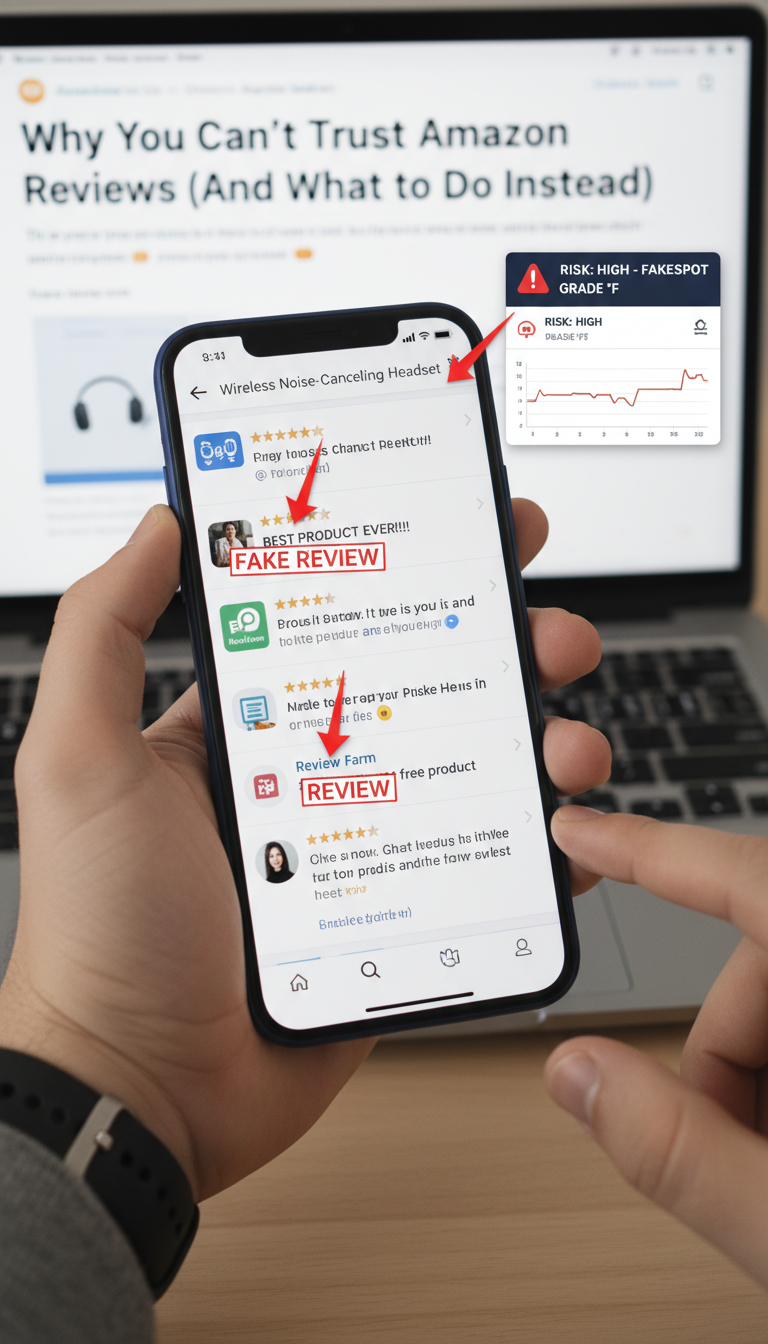
Here is the honest problem with any Amazon-only review analyzer. The data it has to work with is the same data Amazon already shows you. Sophisticated review farms have learned exactly what these tools look for and have engineered their reviews to pass. Real people are paid to use the product for two weeks before reviewing. Posting cadence is paced over months. Language is varied. Reviewer accounts have legitimate purchase histories.
The result is that an Amazon-only analyzer reliably catches the lazy fakes and reliably misses the well-funded ones. If a brand is willing to spend on quality fake reviews, those reviews will pass most checks. So while review analysis is useful, it is not a complete answer on its own.
The best Amazon review analyzers in 2026
Three tools are worth knowing if you want to analyze Amazon reviews before buying.
RateBud
RateBud is the closest current tool to the old Fakespot and ReviewMeta workflow. You paste an Amazon URL, it analyzes reviewer profiles, posting patterns, and language signals, and it returns an adjusted rating with the suspicious reviews stripped out. Free, no login. Best for shoppers who want a fast yes/no on whether a star rating looks inflated. The limitation is the one shared by every Amazon-only tool: it sees only what Amazon shows it.
TheReviewIndex
TheReviewIndex is less about flagging fakes and more about summarizing what reviewers actually say. It clusters reviews into topics and shows you, for example, that buyers love the battery life but complain about the strap, with rough percentages for each theme. This is the more practical job when you have already decided the listing is real and you want to know its weak points. Treat it as a comprehension tool rather than a fake review filter.
SeekShop
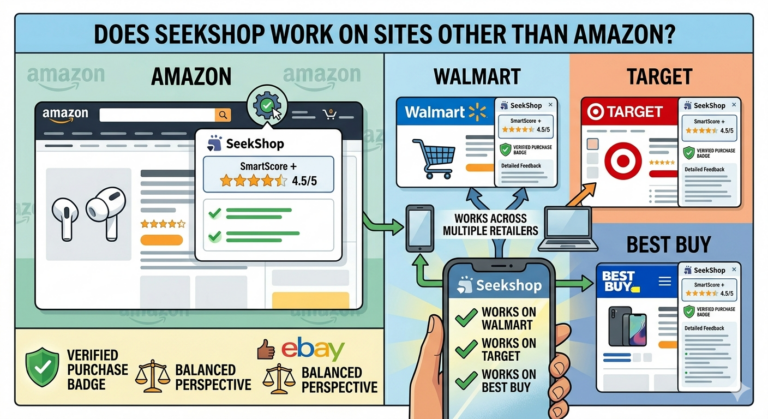
SeekShop solves a different problem. Instead of trying to clean up Amazon’s review data, it analyzes what people are saying about the product elsewhere: Reddit threads, YouTube reviews, and on-site sentiment across 1,000+ retailers. It combines those signals into a SmartScore that reflects how the product is actually performing for real owners over time. This is a different kind of amazon review analysis, because it is not really about Amazon at all. It is about the conversation around the product, which is much harder to fake at scale. SeekShop runs as a Chrome extension and on the web at seekshop.co/review/, both free.
The Takeaway
An Amazon review analyzer is a useful tool. It will catch the obvious manipulation and help you understand what reviewers actually care about. But the harder kind of fake review, the kind that has been engineered to pass these tools, is exactly the kind that costs you money when it fools you. The most reliable way to check a product is to combine review analysis with what real buyers say in places that are harder to manipulate, which is what SeekShop is built to do.
For more on how to compare options side by side, see our guide to the best Amazon review checkers. For a deeper look under the hood, here is how SeekShop aggregates reviews across Amazon, Reddit, YouTube, and 1,000+ stores.
Add SeekShop to Chrome free and start checking products with sentiment from beyond Amazon, automatically, on every product page you open.